
a ballad for my best friend // Hayden Armos
deranged, I asked if you would come
with me into the pink abyss.
you said, it doesn’t matter what color the abyss is.
instead, let's say the abyss was a tunnel.
from judge Todd Robinson: “a ballad for my best friend” cartwheels on a knife’s edge for forty sublime lines, innocence grappling with experience, sense with sensibility, delight with torment. It’s such a nimble and inviting poem, rich in charms and vexed with harms. The sound and sense here! Each verb a plosion, the momentum relentless as the tenderness. I would give much to write a poem this sweet and salty, this luminous and lonely. The poet constantly swerves, yet strikes their target with an unerring eye. This is serious play; this is joyful work.
for M
1.
deranged, I asked if you would come
with me into the pink abyss.
you said, it doesn’t matter what color the abyss is.
instead, let's say the abyss was a tunnel.
train tracks lined the tunnel—the downward pitch of it.
graffiti swarmed the walls. laughing, you said,
let's race, and you threw off your shoes.
together, we somersaulted down
that hysterical kaleidoscope of nonautonomy.
afterward, like little kids,
we made up stories about what we saw.
for you it was: shame, shame, shame.
I said, me too.
2.
and, because you had me feeling sentimental,
I also told you about the horse I met—how at first
she was shy inside her luminous coat.
from the edge, she observed me falling
and burning, all meteorite-like
and ablated.
what I had become: a bright red ache.
the horse came to me then,
and as she unteased me from the wreckage,
the song of my heartbeat
against her bones was full and sweet.
you see, I had just one thing
left to give the horse.
I gave her rivers and rivers of it.
3.
one day, when I am old and gone,
you will remind me of the California poppies
waving us on with their caution orange,
the rolling hills flashing
green in our teeth. and I will tell you
of the anadromous fish—
how, against all odds, an alewife
swims ten miles upstream
to die in the same place it was born.
you will say, that's so me, and
I will nod, strumming my June guitar,
watching as fireflies punctuate
the black sky with their light.

Hayden Armos (he/they) originally hails from an island in the heart of the Pacific Northwest's Puget Sound. After graduating from college, he settled in the San Francisco Bay Area, where he currently lives with his ex-roommates’ two cats and works at a youth services nonprofit. His poetry explores intimacy, attention, wonder, and grief. You can read more in Gigantic Sequins, Salt Hill Journal, Press Pause Press, and Lost Pilots Lit. Instagram: @harmosarmos
Pretend // Tricia Knoll
Let’s play spaceship in this generously decorated refrigerator box which pretends to guard against heat, meteors, and news flashes about dead friends.
from judge Todd Robinson: “Pretend” is as capacious and possibility-dazzled as the decorated refrigerator box it describes. The warmth of its invitation lowers a reader’s defenses, hurtles them through imaginal realms and hallucinatory terrain rich in visual sweets and psychic threats. In the wobble of space, the wonder of world-grit, the necessary palliative of friendship, this poem expertly braids possibility with reality, deft details with lightsome rhymes. Read it and be renewed.
Let’s play spaceship in this generously decorated refrigerator box, which pretends to guard against heat, meteors, and news flashes about dead friends. We crave escape. You wear your green frog hat; I drape my shoulders in my cape of Haida design. Let’s paint our fingernails black and sit cross-legged on purple pillows. Leave Earth singing wheels on the bus as if we are children. Fortify our lunch box with poppy-seed cake for a coffee break. Let me captain our ship for the first leg, where we jettison the thruster rocket of my obsession with today’s disheveled floods and fires and your dismay at your family’s betrayal. You take over when we wave to the moon, view earth war-torn, swirling with hyperstorms, a green of promise, blue of forgiveness. I don’t know how long it takes until we decide to turn back. We can’t be gone forever. My head rests on your shoulder, along with cake crumbs on your shirt. You hold my thumb until you guide our glide home, release the parachute for a soft landing in a heaving sea. To reawaken to wind on our skin. A pretend that mends. With the help of a friend.
Tricia Knoll’s The Unknown Daughter was a finalist in the 2025 New England Poetry Club chapbook contest. More than 300 of her poems appear in journals and and nine collections, full-length or chapbook. Wild Apples (Fernwood Press) details downsizing and moving 3,000 miles from Oregon to Vermont. After 18 years of working with free verse, she is now writing mostly prose poems. Fernwood Press will publish her full-length poetry book, Gathering Marbles, in July 2027. Knoll serves as a Contributing Editor to the online journal Verse Virtual. Website: triciaknoll.com
Homespun // Molly Quinn
“They’ve done it again, those bastards,”
I grumble to him of the greed growing in our small town,
choking out the loveliness that used to flourish here.
“They’ve done it again, those bastards,”
I grumble to him of the greed growing in our small town,
choking out the loveliness that used to flourish here.
He listens and slices a tomato to the rhythm of my rant,
red and ripe and freshly plucked from someone else’s garden
(a neighbor or a friend from work, perhaps).
His careful fingers plate the uneven pieces
then sprinkle them with pepper and salt.
He thoughtfully places the dish between us
without a word.
I look at him and he gives a nod—
a final beat to my tirade.
We feast in silence on the summer fruit
as if we were gods devouring ambrosia.
Such a small gesture to share a
simple plate of sliced tomato, homespun
hints of earth and sun within
its tender flesh, yet in this quiet moment
the whole world, all of it, is a tomato–
garden grown and given to me
Molly Quinn is a poet and incurable romantic. She lives in a town snuggled within the Ozark Mountains, where she works as a librarian. In her off time, she enjoys reading, writing, and finding meaning in the mundane.
The Shoemaker Finch That Does Not Exist // Les Bares
The serrated edge of a leaf on a beech tree
saws holes in the breeze, spins whirlpools
of air from its pointed tip.
It seems to be trying to tell me something
as it goes about its business being a leaf.
The serrated edge of a leaf on a beech tree
saws holes in the breeze, spins whirlpools
of air from its pointed tip.
It seems to be trying to tell me something
as it goes about its business being a leaf.
I populate the tree with a shoemaker finch,
a bird with hints of orange under its wing joint.
A bird I have apparently invented
as the internet tells me there is no such thing.
This cobbler bird hatched somewhere
in my fantasy flits invisible on wind currents
stirred by the knifelike edge of a leaf.
The tree itself is real, or I hope it still is
there on the shore of Lake Ontario.
I remember it, grand, with all its proclamations
of love carved into its silver bark.
The shoemaker finch, which does not exist,
warbles its buzzy slur, blessing young lovers
kissing beneath the beech tree. Their ardor
going extinct before it can be engraved
in the bark, before it too can ever be named.
All the while, the turbulence of a beech leaf
is sawing holes in what never existed,
or what is invisible to the naked eye.
Les Bares lives in Richmond, Virginia. He was the winner of the University of Virginia 2023 Meridian Journal Short Prose Prize and the 2018 Princemere Poetry Prize. His work has or will appear in The Midwest Review, The New York Quarterly, Spillway, the Irish Journal Southword, the English Magazine Stand, and other journals.
The Sundered Seams // Michael McIrvin
The man, considering without cease
how his world will soon be split to atoms, takes
the hand of his boy, who just asked if God
is in this gold-lit meadow among seedheads
heavy and swaying
For Eli and Jesse
Suffering is alchemy, change is God...
- Marilyn Chin
The man, considering without cease
how his world will soon be split to atoms, takes
the hand of his boy, who just asked if God
is in this gold-lit meadow among seedheads
heavy and swaying, insects turning light
to sound as aspen leaves shimmy, birds
singing under blue and intangible white, the day
turning down through every shade of heaven.
The child reaches to be carried and is asleep
before his head hits the man’s shoulder.
The child who will one day ask that his world
be mended, every wounded atom sewn
back together by a magical seamstress,
her thread made of sunlight and bee buzz
and the slightest breeze.
The child whose younger brother, not yet old
enough for these mountains, will someday ask
the same question after waking from a dream-
rescue of younger children assaulted by storm:
the dream hero who will himself, when grown,
pray to be saved from yet another terrible rending.
These children, who have not heard talk of God
and yet can read the name as it is written
on the dying page of a late August afternoon,
in fly dance and lark flight and every turn of leaf
and flower and stem, who can hear the name
shouted in a dream tempest that will become life.
The child in a far town, someday-dreamer-of-God-
in-a-fearsome-wind; the child cradled
in the man’s arms, sleeping soundly
as if any universe could ever be less than whole.
The man, as he walks this two-track road, whispers
lessons of care and grief for his sons, whose lessons
for him, the divine nearly shouting in their small voices,
are of beauty beyond measure. Not just in love’s
every breath but in the sundered seams, in the sky,
faltering blue or black-and-spinning. Within
the inevitably failing light between
whereby we all are transformed.

Michael McIrvin is the author of several poetry collections, including Optimism Blues: Poems Selected and New and Hearing Voices (Fearful Symmetry, 2020). His most recent novel is The Blue Man Dreams the End of Time. Michael lives on the High Plains of Wyoming.
Charcoal Husband // Tomias Keno
They’d put her in the side room by the vestry, the dusty one, where spare chairs were stacked to the ceiling, and a faded poster declared “Welcome new believers” in a font last seen on a yogurt lid.
from judge Teresa Carmody: With humor and playfulness, “Charcoal Husband” explores the uncanniness of connection—how those closest to us can become the most unfamiliar: forgotten, strange, the ones we can no longer quite remember. And then it’s the whole community, trying and failing to help us see what we cannot—the full, shifting complexity of ourselves and of others.
They’d put her in the side room by the vestry, the dusty one, where spare chairs were stacked to the ceiling, and a faded poster declared “Welcome new believers” in a font last seen on a yogurt lid.
From the sanctuary came the soft rustle of people trying not to rustle, a few strategic coughs, and someone’s phone bursting cheerfully into “Angels” by Robbie Williams. There were one hundred and forty-seven people out there. She knew because her mother had mentioned it roughly one hundred and forty-seven times during the planning.
“You don’t want to come out because...?” asked Kaylee, the Maid of Honor, leaning in at a cautious forty-five degrees to keep her hair from brushing the doorframe.
“Because I can’t remember his face,” said the bride, as calmly as ordering a salad. She hoped the calm might make it sound less strange.
“But it’s just... it’s Dan.”
“Right,” the bride said. “Dan, sure.” She could remember Dan’s voicemail: Hi! It’s Dan! Leave a message after the beat! followed by truly terrible beatboxing. She could recall his handwriting, somewhat. His neck, definitely, five angles of it, especially the angle when thinking hard.
Kaylee smiled a smile that was sympathetic, but not so sympathetic that it looked like she’d chosen a side. “What if you close your eyes and try again?”
So the bride did. Tried again to find him. A sturdy nose, maybe. Lips with volume. Kind eyes? People always said kind eyes about men with nothing else to recommend them. And she needed a recommendation, a reason. Without his face, the man of her dreams was suddenly just... a man. And marrying any man wasn’t really her sort of thing.
From the hallway came a whisper, not nearly quiet enough: “How’s she doing?”
“She’s trying,” Kaylee answered.
The bridesmaids slid in then: three women in a colour that had been described in the email chain as “sage,” but in real life leaned more toward “unicorn pink.”
“Sweetheart,” said the one with the clip-on ponytail, crouching until her knees popped audibly. “We hear you’ve gone a bit... wobbly.”
“I can’t see him,” the bride said. It felt like confessing she’d started doubting the moon landing.
“Don’t be daft,” another bridesmaid said, whipping out her phone and scrolling through a gallery of men who all could plausibly be hers, each holding a drink. “There!” she said triumphantly, landing on one of him by a barbecue, squinting like sunlight was a personal enemy. “Face.”
“If that’s him,” the bride said, “then he’s better at being a photograph than a person.”
The bridesmaids laughed that particular laugh women do when something isn’t funny. Then they looked at one another, as if, between them, a solution might appear. Only silence did, and the distant sound of a flushing toilet.
When the bridesmaids drifted out, others drifted in: a slow procession of girlfriends and distant cousins, drawn by curiosity and duty, armed with good intentions.
“Honey,” Aunt Rita said, sitting so close their dress fabrics whispered against each other. “He’s a good man. He brought paper plates to my barbecue without being asked. Who does that? A good man.”
The bride nodded. She could picture paper plates, yes. But not the face handing them over.
“If you can’t remember his face, so what?” Aunt Rita continued. “What is a face, really? Nostrils. Holes! You’re not marrying holes.”
“Eyes too,” Kaylee offered, trying to be collaborative.
The bride wanted to say: But it matters that I see him. It matters that when I imagine him saying, “I do,” I see the particular shape of his mouth making it. That’s how you promise. Otherwise, it’s like promising to a crowd. But she only nodded.
Then came another woman, relation unclear, who pressed a hard caramel into her hand and said: “My Harold never had much face to speak of, and we’ve survived thirty-two years.” The bride wanted to find that comforting, but it only conjured an image of herself on a sofa beside a lifelong blur.
The room was filling fast with helpful women and unhelpful advice. Voices overlapped until the door opened and conversation dropped dead. The bride’s mother entered the room the way celebrities do in supermarkets. “I have been sent,” she announced. “Honestly, darling, this is melodrama. You’ll remember him the second you see him. You’re just having a moment.”
“I’m having a moment where I cannot recall his face,” the bride said, slumped in the only nice velvet chair, hair as defeated as her voice.
“That’s perfectly normal. I couldn’t remember your father’s face until well past the
honeymoon.”
The room went quiet. Even Kaylee stopped pacing. The bride looked at her mother
properly for the first time all morning.
Her mother adjusted her weight, resettled her handbag on her arm. “Well, I mean,
obviously I knew what he looked like... in theory. But if you’d asked me to describe him, really describe him, to pick him out of a crowd or what have you...” She trailed off. “The point is, faces are not what marriage is about.”
“What is it about, then?”
Her mother looked genuinely flustered now, a rare event for a woman who held strong opinions about the correct orientation of cutlery in the dishwasher. “It’s about partnership,” she said finally. Then, in a careful tone, like unlocking an old safety deposit box: “I have never, not once, kept a face for any man. They blur. But the senses make up for it. Smell gets heightened, for instance.”
“The smell of men?” Kaylee asked, brushing imaginary dust from her sleeve as if the very idea might stain her.
“Of course, men,” her mother said briskly, as though the question were indecent. “I can draw your aunt Susan’s pores from memory.” Aunt Susan nodded proudly.
Then the door opened, and in swept Dan’s mother, carrying the expression of a woman who might be about to lose a deposit. “Is she...?” she began, then saw the droopy bride and transformed the concern into a smile. “Sweetheart. He is beside himself.”
“Men don’t love being humiliated,” her own mother said, kneeling to tug at the bottom of the bride’s dress as if smoothing out wrinkles might restore her memory. “Think of Dan. He’s a catch.”
Everyone nodded. The bride thought of Dan catching things: a bus, a cold, the jar she’d once dropped, making pasta. “A catch,” she repeated, as if saying it might reel in his face.
Dan’s mother knelt beside her and clasped her hands. “I raised that boy,” she said. “He’s a good boy. Not perfect, nobody is, but good. He’ll never leave a thing half-done. Laundry? He’ll finish it. Conversation? He’ll finish it. If he tells you he’ll be somewhere, he’s there.”
“He was late to our second date,” the bride heard herself say.
“Traffic,” Dan’s mother said swiftly. “Probably a missed turn. He doesn’t do well with lefts. My family, we’re not a left family. But you know that by now.”
Her mother nodded. The two women stood like mismatched bookends: hers tall and
angular, Dan’s small and round. Different shapes, same expression: waiting for her to come to her senses. And she wanted to, she just couldn’t remember where they were.
“Describe him for me,” the bride asked. “Without saying, good boy. Without mentioning his job, his hobbies, or the way he makes roast potatoes. Describe how he looks.”
Dan’s mother lifted her hands, palms up, and made little sculpting motions in the air, as though kneading the idea of him. “He has a... warmth,” she said.
“So does a radiator,” said the bride, not unkindly.
“His eyes,” her own mother said, hand darting. “They’re very... present.”
“Eyes must be. It’s biology,” said the bride. “Otherwise, we call a doctor.”
The smallest bridesmaid, revived by the chance to finally be helpful, added: “He’s six foot.”
“That’s a length,” the bride said.
There was a small, sympathetic laugh across the room, then quickly suppressed, like a sneeze in a lift. For a moment, they all thought. The bride could feel it happening, the slow bloom of an idea, something subversive, a little oil spill spreading: maybe it wasn’t unreasonable to want a face to love. Without one, you were left with a man. And a man, as a category, was rather a lot.
The bride wondered what the groom was doing out there with his uncooperative face. She pictured a kindergarten drawing of a man: round head, two coin eyes, a line for a mouth. She hoped he wasn’t sad. She didn’t want to be the cause of male sadness, but she also knew men’s sadness had a way of expanding until it needed its own postcode. What about hers?
The vicar’s wife entered with the efficiency of a woman used to patching crises. “We’ll say there’s been a leak,” she said. “There’s almost always a leak in these old buildings.”
Aunt Susan tilted her head. “Well, he does have nice teeth,” she offered, but no one could quite picture them anymore.
***
Because women are a natural committee, they instantly formed a focus group. Within minutes, someone had fetched a cousin who used to draw criminals for the police and now did commissioned portraits of Labradoodles. She arrived with a charcoal pencil and authority, sitting on a folding chair as if it were a throne.
“Describe his face,” said the sketch-artist cousin, whom the bride mostly remembered for selling wax melts on Facebook. “Start with the top. What’s his hairline doing?”
A pause. No one wanted to say balding in a church. “It’s... tidy,” Kaylee offered.
“Eyes?”
“They’re a normal color,” said the organist’s wife, beginning to sweat.
“A nice smooth brown,” a bridesmaid added, cautiously. The bride pictured gravy and wished she hadn’t.
The cousin’s charcoal began to gather shape: a forehead, an earnest brow. Half a man, but more than a blur. It worked better than the photos, the bride thought. A drawing, even half finished, felt closer to memory; less about accuracy, more about point of view.
“His mouth,” one of the bridesmaids said. “Always thought it looked a bit... animal.
Moose-ish, maybe.”
The bride flinched hard enough for a curl of hair to spring loose. Everyone noticed.
“Teeth!” Aunt Susan blurted, with the false cheer of someone yanking a conversation back from the brink. “What about teeth?”
“We’ve acknowledged teeth,” the bride’s mother hissed. Never a good sign, the bride thought, when the entire room had already pictured them once and chosen not to revisit the experience.
A teenage cousin appeared in the doorway, eyeliner sharp enough to notarize documents. “I’ve always thought Dan looks rather like a man from a car insurance advert,” she said, leaning against the door frame. “No offense.”
“We’re being positive, Zoe,” hissed a bridesmaid.
“I am being positive,” said Zoe. “Someone somewhere might call that hot.”
The women sighed as one. They could all see it now: the man appearing on the paper wasn’t someone you’d cross a room to marry. He was someone you’d politely let merge in traffic. They began to argue, gently insisting that faces didn’t matter, composing small mercies for the chap on the paper. The bride recognized the tone: the same one women used when convincing themselves to keep walking: down aisles, into houses, into compromises shaped like people.
Aunt Rita tried her usual refrain: her husband could fix things around the house. But at least Rita could see the man fixing things, could recognize the face she loved and called hers.
“Listen,” said the bride, sitting up in her velvet chair. Her tone made them all lean in.
“You all know his face, but imagine him, as I must, without one. Picture just the blur of a man. Would you be thrilled to go home to such a blur? Every night? Forever? The blur will have opinions about shelving. The blur will say, ‘I don’t think we should get a dog.’ The blur will, at Christmas, buy you something with the word set on the box. But if there’s a dazzling face instead of the blur, or at least one that feels like home, you forgive him everything else, because you have something to hold, a place to rest your wanting. Without it, all you’ve got are the logistics of a blur. Do you see?”
They did. You could watch the understanding pass through them, a neat little relay. Yes, oh God, yes; Christ, the blur. The organist’s wife looked faintly ill.
Dan’s mother, bless her, made a final stand. “He has dimples,” she said, gripping the word like a handrail, but the damage was already done.
The room had the hush of women examining evidence from a crime they hadn’t realized they were part of. “He once said he makes a mean risotto,” Aunt Susan said. “I asked what’s in it, and he said, ‘Whatever she tells me to.’”
“He eats yogurt with a fork if the spoons are dirty,” said his sister, who had been quiet until now.
“He claims he’s vegetarian,” said Zoe, “except for kebabs.”
The vicar’s wife, who had seen many marriages up close and had a professional interest in them not collapsing, tried to perform a tiny reset. “All right,” she said, kind but brisk. “What we are confronting here is that attraction, specifically facial, is the lubricant that makes the machine go without smoke. And if the lubricant is gone...”
A timid knock interrupted her. One of the ushers poked his head in, smiling with the
earnest optimism of a Labrador. “Just to say: we can fit in another hymn, if that helps? Or maybe something modern? People like modern.”
The vicar’s wife guided him out gently, narrating an image of the women mopping puddles together.
“Life with a man can be delightful,” Aunt Rita said, attempting to finish the thought, but the sentence had the weary tone of someone describing a cat who sometimes comes when called. “There are... kindnesses.”
The women looked at each other with that frank, conspiratorial kindness they reserved for moments when the truth got out accidentally. The bride could feel them all tilting, gracefully, toward a shared realization.
“We are not against men,” the bride’s mother said diplomatically, to the air. “Men are fine. They’re like street signs: you’re glad they’re there. But you don’t take comfort from a sign you’ve never seen before. You want the one that tells you you’re nearly home.”
A bridesmaid giggled, then slapped a hand over her mouth, as if she’d just violated a church law.
“Does that mean we can start?” asked Kaylee. “I’ve got a thing at three.”
Before the bride could answer, the door creaked open with the slow hinge of someone afraid to interrupt. “Hey,” said a man, the word landing in the room just ahead of him. His voice had that soft, friendly register the bride remembered from so many small moments: post office lines, whispered jokes in bed, the time he’d spoken to a bird that flew into the house.
But when she saw him, the real, physical him, the remembered Dan refused to appear. A few parts clicked (oh, that chin; those eyelashes, yes), but mostly she saw someone new. The lines deeper; the hair slightly thinner. Not bad, she thought. For a stranger.
She noticed a scar on his left eyebrow she’d never clocked before, a pale line, as if
someone had taken a pencil to him and changed their mind halfway through. After today, she would always see that scar. She wondered how much else she had missed: maybe a crooked tooth behind his lip, or a twitch of the nostril when he was about to lie.
Dan said nothing. Just looked faintly panicked, as if he could smell what they’d been talking about. Then her brother barged in. “Sorry to bother you,” he said to the room full of women. “It’s just, Dan’s got this little problem with... memory.”
“Only the face,” said Dan. “I remember everything else.”
“Join the club,” said the bride.
Dan’s face did a small, familiar thing, an almost-smile that never quite made it. She felt a slight click of recognition. Not for his face, but the kindness that had always lived behind it. It felt like a relief in the stomach, something quietly untangling.
“I couldn’t pick out Harold’s eyes in a line-up,” Aunt Rita began cheerfully. “But he’s got this dent.” She tapped her forehead. “Says it’s from a cricket ball in ’84, though we weren’t yet acquainted in ’84, so I cannot verify. Still, I’ve loved that dent like a family pet.”
“Naso-labial fold,” Aunt Susan intoned, with the devotion of someone reciting scripture. “On Lilian, it runs deep, like the path water carves when it’s patient. Sometimes I dream of that fold.”
“Birthmark,” shouted the organist’s wife, her eyes bright. “He has one on his forehead. If it vanished, I’d be bereaved.”
There was murmuring, nods. Someone said, “Crow’s feet,” softly, like a pilgrim naming a shrine.
“Every one of you has a smaller nose than I,” murmured the bride’s mother, as if
confessing to a crime.
“I have one ear that’s lower,” said Kaylee, tugging her hair to show it. “In photos I tilt, like I’m eavesdropping on a secret.”
Bridesmaid Chloe began to cry. “I keep forgetting my children’s faces,” she said. “Google says hormones. I truly hope so.”
And then the litany gathered rhythm, a cadence. They spoke of freckles, eyebrows, and the myth of symmetrical nostrils. Of mouths not as kiss-machines but as small, unique puzzles: lips that met reluctantly, lips that gaped a little.
People who hadn’t been invited began to drift in, drawn by the strange electricity of
honesty. Someone laughed, and then everyone did, the kind of laughter that isn’t cruel, just human. A shared relief at the absurdity of all of us, walking around, wearing faces.
Through it all, the bride and groom stood together, as if posing beside a museum exhibit. Their hands found each other. Warmth flowed between them, carrying wordless messages. He fidgeted; so did she. She squeezed him. He squeezed back the exact amount, the honest clasp of someone with nothing to prove and nothing to hide.
The charcoal drawing lay on the floor: a faint smudge of a man, not yet trampled but well on its way to being forgotten.

Tomias Keno (1990) is a Dutch author, screenwriter, and singer-songwriter working at the intersection of literary fiction and science fiction. His work won first prize at the 2025 Dubai Future Stories Awards, held during the Dubai Future Forum. His literary fiction has appeared in Dutch literary magazines, including Op Ruwe Planken, DwB, de Optimist, and deFusie, and he is a finalist for the 2026 Indiana Review Prize. In 2022, he launched Astronaut, a multidisciplinary project combining a novel, a fiction podcast, and a pop album; the podcast became the most listened-to fiction series in the Netherlands and Belgium and was nominated for the Rose d’Or, the NTR Podcast Prize, and the Belgian Podcast Awards.
The Middle of the End // Elena Ender
I can smell the tar bubbling up and oozing down the street as a sign of the end times. The cars get gobbled, and the drivers climb out of their windows to sit on top of their hot roofs until someone brings them a small bridge to get them to the sidewalk, a mound of pillows, or a plank of wood, perhaps. Our death is inevitable, but at least we can help our neighbor get back to their lawn where they step on frogs, fallen from the sky, croaking over and over.
I can smell the tar bubbling up and oozing down the street as a sign of the end times. The cars get gobbled, and the drivers climb out of their windows to sit on top of their hot roofs until someone brings them a small bridge to get them to the sidewalk, a mound of pillows, or a plank of wood, perhaps. Our death is inevitable, but at least we can help our neighbor get back to their lawn where they step on frogs, fallen from the sky, croaking over and over. I can hear the cicadas scream in chorus with the frogs, buzzing a harmony that only a mother could make you feel guilty about.
It’s because you had premarital sex, she says over her morning coffee, doing the crossword and hearing the pitter-patter of blood drizzling on the aluminum siding of my childhood home. And it was gay, she bemoans. I moved back in at the beginning of the end, but the apocalypse hasn’t fully taken enough time out of my day to keep me a safe distance from Mom’s grumblings. She is retired.
I don’t think the world is ending because I had premarital gay sex.
You never know, she shakes her head. But it surely wasn’t me. Dad cleans up the messes that seep indoors, but knows his favorite lawn-maintenance tasks are a lost cause. If I am the reason for the apocalypse, I’d mostly feel guilty for that; he loves taking care of the hydrangea bushes.
I still work remotely, writing social media ads for an agency that represents some questionable corporations. I’m getting paid, but not paying rent, and also going out much less, obviously. So if the world sticks around for another two years, I would maybe be able to afford a down payment on a condo in the city. It’s unlikely, but it would be kind of nice.
None of my friends live in the area. It’s all just people I knew from high school who never left. It’s embarrassing seeing them again after so long, especially feeling like I failed for not hacking it in the city through all of this. It was just so on fire.
I try to keep up with my friends from the city, but not many of them are in places with cell service or general livability. Everyone without a plan was invited to join me, but no one wanted to share a bedroom. I mean, I get it: I snore, and I am bad about putting laundry away.
The days move slowly as the world waits for a merciful close. After the initial uproar, we became and remained relatively quiet and level. I stopped dreaming a few weeks ago; I just sleep in static and wake up to an unfriendly alarm.
During the hours between storms, a hot, orange dusk, I take our old dog Benny for a walk. He sniffs the curb clovers and pulls at his leash to catch up to the creatures that have fallen from the sky or unearthed from below. He never tries to bite, though, and he never even growls. He just wants to play.
Elena Ender spends her time writing silly little stories, scouring local dives for live music, and clowning around with her friends in Portland, OR. Her debut chapbook, Still Alive, I’m Afraid. is available now thanks to Bullshit Lit. You can find her online as: @elena_ender.
Lobo, King of the Dogs // Lenore Weiss
I grew up amongst older kids, counting bees and straining chunks of sandstone into empty soup cans. I watched cats play with dead mice and then ran up the block to an abandoned house filled with ceramic bowls heaped with flies. Like us, there were dogs, strays that wandered in the neighborhood sniffing garbage cans.
from judge Teresa Carmody: Every childhood is mythical. If we’re lucky, we grow older. And if we turn toward language to remember how it was, we might just conjure the many mythical creatures that lived alongside us. I love the voice in this piece—the contemplative hush of it, and its unexpected turns of phrase and image.
I grew up amongst older kids, counting bees and straining chunks of sandstone into empty soup cans. I watched cats play with dead mice and then ran up the block to an abandoned house filled with ceramic bowls heaped with flies. Like us, there were dogs, strays that wandered in the neighborhood sniffing garbage cans. My playground was the lot that adjoined our apartment building; it’s where I climbed pretend mountains to explore new countries, where I studied flowers and whatever happened to grow in broken glass–clover, chicory, and dandelions, the local flora of the Bronx that took root amidst the discarded empty TV boxes that became our playthings. We rolled in them until we became dizzy-sick, our sides sore from neighborhood kids kicking outside the box.
Sometimes, in the summer, I’d walk with my family to City Island east of Throgs Neck, surrounded by the Long Island Sound, where restaurants served up fried oysters, clams, and eels. I thought the world consisted of the Manhattan skyline held together with roasted coffee from the Café Bustelo factory—a smell that will forever be enshrined in my memory, together with garbage festering outside our building in the summer heat.
If I wasn’t playing in the vacant lot, I held court upstairs in our one-bedroom apartment, on cold days sifting through the contents of a toy box stored in the foyer, just beneath the dumb-waiter that had been used at some point as a garbage disposal, but now served as a highway for cockroaches, allowing them to make excursions throughout the building. The bugs persisted no matter how much we crushed, sprayed, or stepped on them; the small white ones were the babies. The toy box, on the other hand, easily exposed its gifts, which included a stuffed squirrel my father had given my mother during their courtship days, and as such, an artifact of love. There was a mismatched collection of building blocks and a plastic bag that included a lump of clay, too hard to shape into anything, but nonetheless still interesting. Next to the toy box was the hallway closet (my parents’) with a box of comics and a wine-colored velvet bathrobe. On days when I was sick, my mother allowed me to use it as a cover.
In kindergarten, my teacher was not the warm-hearted woman who ushered her charges to their seats with a loving smile. Her hair was so thin, I could see her scalp. She believed in disciplining children by making them stand in the darkest corner of the clothing closet. The only happy thing I remember about her class was looking into a kaleidoscope, but that wasn’t enough to forgive her, in addition to the sour containers of milk she handed out every morning.
Leaving home for kindergarten made me feel sick. I was happy to sit in the apartment and examine the many shoes that had been pushed to the back of the closet, including red and black galoshes, all of which had a rubbery smell and still had not dried out from the last snowstorm, and spend time with my box of crayons, mourning for each one that was no longer whole. I felt insecure in being pushed outside the apartment, where I’d learned to walk holding on to the arm of a chair and scouting my way to a glass table in the living room. Leaving the security of the apartment for school was an excruciating experience.
We lived along Hunts Point Avenue. “The Avenue,” as we referred to it, had dry goods stores filled with nurses’ uniforms and gray wool sweaters, and a stationery store we visited at the beginning of each school year. I loved the store for its pencils and crayons and its notebooks of white composition paper. It was just a few stores up from the delicatessen where they sold corned beef and pastrami sandwiches lacey with white fat, and where some rough-looking older boys stopped me one day to say, “You have a pussy in between your legs.” I looked, but saw nothing.
Beyond the deli, and at the outermost limits of the Avenue, was the Garrison Bakery run by an Italian family who sold black-and-white cookies, five-inch disks with an anise taste. Past the bakery was the Bruckner Expressway, a thoroughfare of cars rushing headlong in opposite directions.
Once I crossed the Expressway, I arrived at the Hunts Point subway station. It was flanked on one side by a newsstand where people bought copies of the New York Post, the Daily News, and also The New York Times, which was displayed in a smaller stack beneath the two other papers. Then there was a triangular park with wooden benches where men, women, and children watched pigeons eat bread crusts. From here, the rest of Southern Boulevard fanned out, home to a toy store and a Chinese restaurant where we ordered sub-gum after going to the movies at Loew’s Cinema, where my mother took me to see every movie by Rodgers and Hammerstein.
The street was our playground.
Summer raced by in baseball cards, roller skates, hula hoops, hopscotch, marbles, jump ropes, bottle caps, highly-prized Spaldeens that were like tennis balls but without a furry outside, water guns, yo-yos, pea shooters, and coloring book season. Girls collected and traded charms. My “best one” was a purple swan. There were frequent rock-throwing battles where the Longfellow and Bryant Avenue gangs tried to see who’d go crying first to the emergency room of Lincoln Hospital.
“You hurt?”
“No, just bleeding.”
I was the hula hoop champion of my block and could ride the hoop from my waist up to my neck and back down to my knees without stopping. One summer, I lost 10 pounds practicing outside on the sidewalk until the street lamps came on. I enjoyed roller skating over a slate sidewalk that adjoined the lot, a smooth ride on heavy metal skates with clamps tightened by a key worn on a dirty string around my neck. A heavy rainstorm flooded worms from their underground homes, pink against the black slate sidewalk. But riding down the hill past the Fire Station was the most exciting, watching out for cars, and at the same time, weaving from one side of the street to the other.
Slowly, I began to conquer the blocks that defined my neighborhood.
My explorations fanned out to Southern Boulevard and to the Hunts Point Palace, which, in its heyday, hosted bands from all over the city, but was now a dance studio. A long set of stairs led to a mirrored practice room where I took tap lessons but never got past learning the time step. Up from the Palace, I found Woolworths where I practiced petty thievery, strolled past fish tanks filled with darting slivers of color, past an aisle of pencils, papers, and notebooks—things I coveted and stole. After I exited through the doors and slunked back home, I shouted to myself, “Safe!” like our tag games of ring-a-levio.
Several boys lived on the block, including Eddy, next door to me, and also Bobby and Brian, Dodo’s (her name was Dorothy) twins, plus Melvin, a boy who’d just moved into the building with his parents, who’d escaped from the Nazis and wore clothing that never fit. People said that was because the family got their clothes from the welfare department. Then there was Ronny, Yetta’s son, who later became a heroin addict and stole whatever he could from his mother, but there was no one like Donny who moved through the neighborhood like a clean knife cutting through cheesecake. For weeks, we watched each other. I wasn’t sure in which building he lived. He had dark hair and green eyes. I sat on the stonewall that bordered the lot and saw him cross the street. He asked me, “Can I sit here?”
Warmth radiated from my thighs, a preparation for something I couldn’t imagine, but at the same time, knew everything about. In one moment, my thighs became sweaty and stuck together. I was about six years old. Donny’s complexion was smooth, and he was close enough to my face so I could see a fine network of hair on his ruddy cheek and also above his mouth. I looked at the stupid Buster Brown Oxford shoes my parents made me wear. He asked if he could kiss me, and I said yes. He held my hand. Then the streetlamps came on. I watched him get up. I remained sitting there, still feeling the outline of his lips. Later, I heard from my sisters that he’d moved away. No one knew where. For years, I longed for a boy to make me feel what Donny had—the unknown danger and excitement of physical intimacy.
Each five years apart, my sisters and I shared a bedroom. They slept together. I slept in a separate bed against the wall, and my parents in the living room on a roll-away couch. After they got up in the morning, I plopped into the upholstered chair and looked out to the fire escape, where, during the spring, I grew morning glories in wooden cheese boxes with seeds ordered from the New York City public school system. My first garden grew on the fire escape.
The seeds arrived in brown paper packets stapled to our original order. They looked like small black canoes with an indentation on top. We soaked them in a glass of water. After a day’s immersion, we’d plant them in a cheese box I had procured in advance from Mr. Kurtz’s grocery store at the end of our street. Back then, American cheese arrived in rectangular blocks and was sliced to order—thin, medium, or thick—wrapped in wax paper, folded, and sealed.
My mother sent me to request an empty cheese box. Mr. Kurtz always wore a white apron and stood close to his register near a display of Hostess Twinkies. He went to the back room of the store and returned with a box about nine inches long. I carried my treasure upstairs. I don’t remember where we got the soil–either from the Five and Dime, or dug some from the vacant lot. We prepared a garden bed for our morning glories by making a hole with the back of a soup spoon for seeds that were slightly swollen and cracked after soaking, pressing them into a prepared row, and covering them up, placing the box in the sunshine outside the kitchen window.
Each day I got up, walked past my two sisters, tiptoed to the kitchen, stuck my head outside the window, and checked on the progress of the seeds. One morning, I looked outside and saw the soil beginning to erupt. Even though I knew better, I used my finger to disrupt the fissure so I could see an individual seed sprout, head bent over like a crooked woman still encased in its seed hat, until it emerged from the soil, growing long and spindly, magically seeking a white string we had saved from a bakery box and thumb-tacked to the window frame. Each day, I’d investigate how much the morning glories had grown. From seeds to seedlings, I watched them wrap and braid themselves along the string. But we had to select the healthiest. We could only grow one or two in the small box. As summer approached, I watched blossoms appear, tightly pressed together like two palms, before they opened into blossoms bluer than Paul Newman’s eyes, bluer than the sky, framing my window.
Some weekends I’d listen to my mother talk with her friends at the kitchen table as they ate slices of her home-baked cake, downed with cups of freshly brewed coffee. My mother filled her yeast cakes with chocolate and nuts; the dough was soft and pliable, the way my mother’s breasts looked when she put on her bra. She taught me Hungarian words for poppyseeds and nuts: mákos and diós, plus the velvety prune butter she used in some of her cakes called lekvár. Around the kitchen table, my mother’s friends discussed everything—which supermarkets were having the best sales, shared tidbits about their children and husbands, and gossiped about the next-door neighbors who were always fighting. I tried to understand how they knew when to move from one topic to the next.
“Tell your change-of-life baby to leave,” said my mother’s friend, Dodo, whose Italian alcoholic husband had died a few years before, an event she had celebrated in her apartment. My mother smiled. She had given birth to me after she’d turned 40 years old, an age when most of her generation was done with having children. Whenever my parents wanted privacy, they spoke Hungarian. But as my mother’s friends only spoke English, they wanted me to scram.
“Oh, let her stay,” my mother said, running her hand through my dark hair. “She won’t bother us.”
Yetta, who lived on the ground floor on our side of the building, didn’t say much. My mother had told me that Yetta was sitting shiva, mourning for her canary that had recently died after seven years of flying around her living room. “How could you?” Yetta spat through the silver bridge wires of her mouth.
“Do what?” said my mother.
“Come downstairs, the two of you dressed in black?”
“But Yetta,” said Dodo, chewing on a slice of my mother’s yeast cake. “We knew you were upset about Charlie,” the name of the dearly departed canary. “How could you think we were making fun?” Dodo always smelled like an expensive cosmetic counter, always applying moisturizers to her face and body. She pulled Yetta’s blouse up on her shoulder and revealed a lavender bra strap. “Matching panties?”
Yetta was the only one who could afford such luxuries. Her husband gambled and gave her a sizable weekly allowance. She indignantly pulled her blouse back down. “Yes,” she said, and always left a bright pink cupid’s bow on the rim of her cup.
Since large pets were not allowed in the apartment building, Dodo feared her dog Coco would be discovered by the landlord. Our family had a parakeet from Woolworths, and it flew in the living room one day. I chased the bird from one side of the wall to another, as it desperately tried to grip the crown molding, and smacked directly into the wall, landing on the floor in a flutter of green feathers. It didn’t move. I pushed its head. It was dead. Only moments ago, it was flying around the ceiling. I buried the bird in a shoebox, but told no one about my culpability.
In junior high (middle school), I began to get sick.
My mother took it as a personal insult that she had a sickly child. How could she, the self-proclaimed Rock of Gibraltar, steadfast in every storm, calm in the face of any adversity, have a daughter whom you could blow over with a single breath?
Any time the doctors prescribed a new food regimen, she discovered health food stores, places outside of her usual shopping route on Hunts Point Avenue.
I went through a gluten-free phase since the doctors thought I was allergic to wheat products. When that didn’t work, I moved on to all-protein diets, eating broiled meat, cottage cheese, and raw vegetables. I cheated as much as I could, pilfering Milky Ways from the closet. Finally, the doctors decided I didn’t have a food allergy.
I knew it was the Sick Monster who was punishing me for killing my parakeet.
In junior high school, the doctors told my mother they wanted to send me to a hospital “for observation,” which turned into a nasty regimen of urine and bowel collection and giving me tests that required barium enemas. On the morning when I was being discharged, I felt the Sick Monster jab me in the stomach with a sharp fingernail. “I will follow you wherever you go. You will never escape me.”
I returned to school and tried to forget him, discovered the library where I read Greek mythology, stories about Psyche whose husband was invisible at night; Grimm’s fairy tales about three tasks that must be accomplished before a prince can find love, or Hans Christian Anderson’s The Little Mermaid who dissolved into a sea of foam, sacrificing her silvery tail for stumpy legs. Love wasn’t going to be easy. All the songs on the radio said so. But I thought it had to be the most wonderful thing in the world, the moment when Emile De Becque in South Pacific spots Nellie Forbush across a crowded room. I also dreamed about making the world a better place. But I couldn’t find books to tell me how I was supposed to do any of this, especially how to find the person who was going to share a roll-away couch with me every night.
Throughout school, I never had a boyfriend.
Maurice was my next-door neighbor. Once he showed me his rock collection with identifying labels. He also had a microscope. One day, we came across a stray dog like any other, with a body lean for the streets, a rib cage visible, black and brown fur oozing around a sore. It was Saturday, several hours before dinner, as days began to shorten and whisper with a cold breath.
My mother had told me never to pet a dog, especially if it were drooling, because that was a sure sign of rabies. One of the twins had gotten bitten by a dog and had to go to the hospital and get injections with a needle that was as long as a baseball bat. I didn’t want to go to the hospital. I backed off and watched the dog from a safe distance. Occasionally, the dog picked up its head and sniffed. Its eyes were green like the pastel chalk we strained over rusted screens and poured into socks on Halloween to pound on people’s front doors.
He told me his name was Lobo.
“Lobo,” I said. “You look hurt. Better hide behind this rock. Don’t let the other kids see you because they might throw rocks. And watch out for Ronny. He’s the meanest. I’ll be right back with food. I promise.” I ran upstairs. I opened the door with my key and hoped my mother was still shopping. I rescued a slice of leftover meatloaf.
Lobo looked at me with his spinning eyes and said that another dog had chased him across Southern Boulevard. He was panting hard. We walked past the washing machine room in the basement. The floor was coated with scum from soap that had flooded countless times. We approached a hole in the pavement where rain had gathered. Lobo lapped up the water and gave me a few hairs from his tail. He said they were magic. If I were in trouble, all I needed to do was to stand in front of a car’s rearview mirror, hold them in my hand, and call out his name.
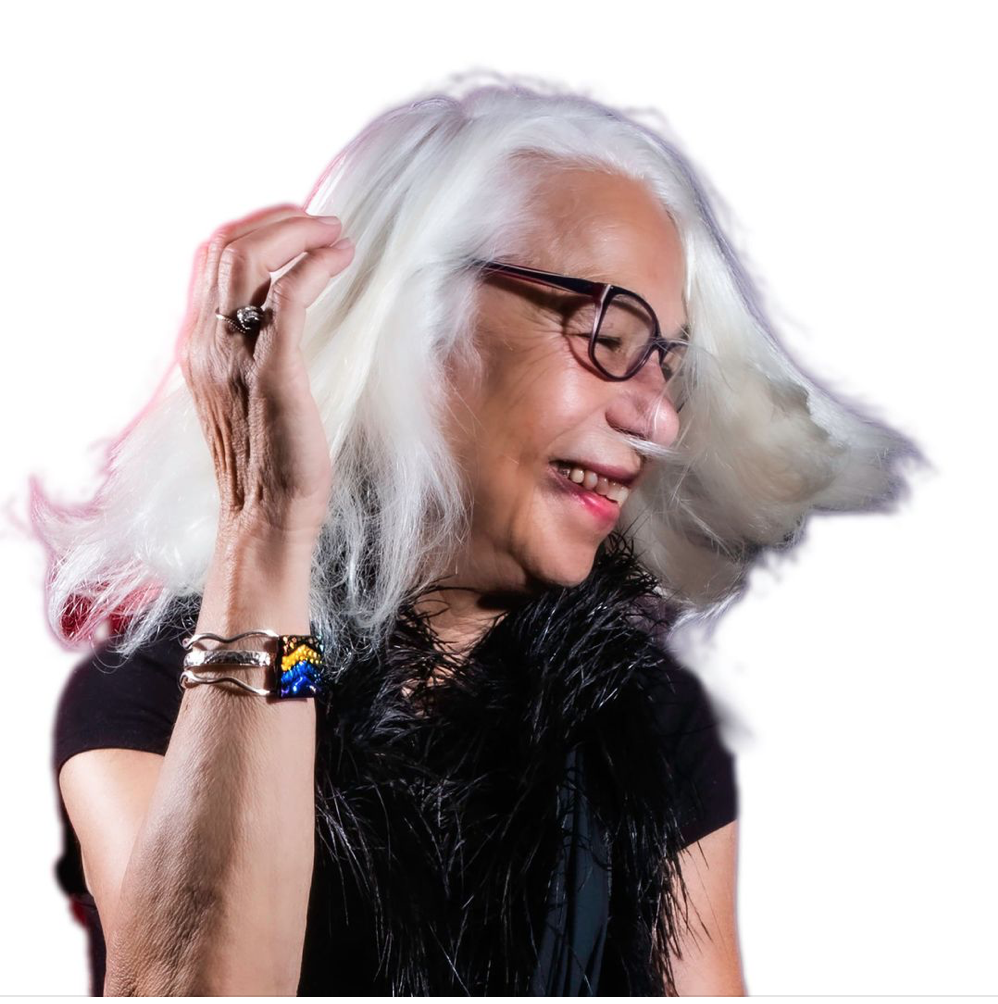
Raised in the Bronx and now based in Oakland, Lenore Weiss is the author of a novel, Pulp into Paper, and multiple poetry collections, including Video Game Pointers (2024) and a trilogy exploring love, loss, and mortality. Her prize-winning flash fiction chapbook, Holding on to the Fringes of Love, was published by Alexandria Quarterly Press. A member of the San Francisco Writers Grotto and Associate Creative Nonfiction Editor for Mud Season Review, she has collaborated across disciplines, most recently on Life into Light, a chapbook about photosynthesis created with scientist Dr. John Bedbrook. She is currently working on her second novel, tentatively entitled "Not a Good Season for Trust." Lenore has led writing workshops and tutored middle school students.