
Lobo, King of the Dogs // Lenore Weiss
from judge Teresa Carmody: Every childhood is mythical. If we’re lucky, we grow older. And if we turn toward language to remember how it was, we might just conjure the many mythical creatures that lived alongside us. I love the voice in this piece—the contemplative hush of it, and its unexpected turns of phrase and image.
I grew up amongst older kids, counting bees and straining chunks of sandstone into empty soup cans. I watched cats play with dead mice and then ran up the block to an abandoned house filled with ceramic bowls heaped with flies. Like us, there were dogs, strays that wandered in the neighborhood sniffing garbage cans. My playground was the lot that adjoined our apartment building; it’s where I climbed pretend mountains to explore new countries, where I studied flowers and whatever happened to grow in broken glass–clover, chicory, and dandelions, the local flora of the Bronx that took root amidst the discarded empty TV boxes that became our playthings. We rolled in them until we became dizzy-sick, our sides sore from neighborhood kids kicking outside the box.
Sometimes, in the summer, I’d walk with my family to City Island east of Throgs Neck, surrounded by the Long Island Sound, where restaurants served up fried oysters, clams, and eels. I thought the world consisted of the Manhattan skyline held together with roasted coffee from the Café Bustelo factory—a smell that will forever be enshrined in my memory, together with garbage festering outside our building in the summer heat.
If I wasn’t playing in the vacant lot, I held court upstairs in our one-bedroom apartment, on cold days sifting through the contents of a toy box stored in the foyer, just beneath the dumb-waiter that had been used at some point as a garbage disposal, but now served as a highway for cockroaches, allowing them to make excursions throughout the building. The bugs persisted no matter how much we crushed, sprayed, or stepped on them; the small white ones were the babies. The toy box, on the other hand, easily exposed its gifts, which included a stuffed squirrel my father had given my mother during their courtship days, and as such, an artifact of love. There was a mismatched collection of building blocks and a plastic bag that included a lump of clay, too hard to shape into anything, but nonetheless still interesting. Next to the toy box was the hallway closet (my parents’) with a box of comics and a wine-colored velvet bathrobe. On days when I was sick, my mother allowed me to use it as a cover.
In kindergarten, my teacher was not the warm-hearted woman who ushered her charges to their seats with a loving smile. Her hair was so thin, I could see her scalp. She believed in disciplining children by making them stand in the darkest corner of the clothing closet. The only happy thing I remember about her class was looking into a kaleidoscope, but that wasn’t enough to forgive her, in addition to the sour containers of milk she handed out every morning.
Leaving home for kindergarten made me feel sick. I was happy to sit in the apartment and examine the many shoes that had been pushed to the back of the closet, including red and black galoshes, all of which had a rubbery smell and still had not dried out from the last snowstorm, and spend time with my box of crayons, mourning for each one that was no longer whole. I felt insecure in being pushed outside the apartment, where I’d learned to walk holding on to the arm of a chair and scouting my way to a glass table in the living room. Leaving the security of the apartment for school was an excruciating experience.
We lived along Hunts Point Avenue. “The Avenue,” as we referred to it, had dry goods stores filled with nurses’ uniforms and gray wool sweaters, and a stationery store we visited at the beginning of each school year. I loved the store for its pencils and crayons and its notebooks of white composition paper. It was just a few stores up from the delicatessen where they sold corned beef and pastrami sandwiches lacey with white fat, and where some rough-looking older boys stopped me one day to say, “You have a pussy in between your legs.” I looked, but saw nothing.
Beyond the deli, and at the outermost limits of the Avenue, was the Garrison Bakery run by an Italian family who sold black-and-white cookies, five-inch disks with an anise taste. Past the bakery was the Bruckner Expressway, a thoroughfare of cars rushing headlong in opposite directions.
Once I crossed the Expressway, I arrived at the Hunts Point subway station. It was flanked on one side by a newsstand where people bought copies of the New York Post, the Daily News, and also The New York Times, which was displayed in a smaller stack beneath the two other papers. Then there was a triangular park with wooden benches where men, women, and children watched pigeons eat bread crusts. From here, the rest of Southern Boulevard fanned out, home to a toy store and a Chinese restaurant where we ordered sub-gum after going to the movies at Loew’s Cinema, where my mother took me to see every movie by Rodgers and Hammerstein.
The street was our playground.
Summer raced by in baseball cards, roller skates, hula hoops, hopscotch, marbles, jump ropes, bottle caps, highly-prized Spaldeens that were like tennis balls but without a furry outside, water guns, yo-yos, pea shooters, and coloring book season. Girls collected and traded charms. My “best one” was a purple swan. There were frequent rock-throwing battles where the Longfellow and Bryant Avenue gangs tried to see who’d go crying first to the emergency room of Lincoln Hospital.
“You hurt?”
“No, just bleeding.”
I was the hula hoop champion of my block and could ride the hoop from my waist up to my neck and back down to my knees without stopping. One summer, I lost 10 pounds practicing outside on the sidewalk until the street lamps came on. I enjoyed roller skating over a slate sidewalk that adjoined the lot, a smooth ride on heavy metal skates with clamps tightened by a key worn on a dirty string around my neck. A heavy rainstorm flooded worms from their underground homes, pink against the black slate sidewalk. But riding down the hill past the Fire Station was the most exciting, watching out for cars, and at the same time, weaving from one side of the street to the other.
Slowly, I began to conquer the blocks that defined my neighborhood.
My explorations fanned out to Southern Boulevard and to the Hunts Point Palace, which, in its heyday, hosted bands from all over the city, but was now a dance studio. A long set of stairs led to a mirrored practice room where I took tap lessons but never got past learning the time step. Up from the Palace, I found Woolworths where I practiced petty thievery, strolled past fish tanks filled with darting slivers of color, past an aisle of pencils, papers, and notebooks—things I coveted and stole. After I exited through the doors and slunked back home, I shouted to myself, “Safe!” like our tag games of ring-a-levio.
Several boys lived on the block, including Eddy, next door to me, and also Bobby and Brian, Dodo’s (her name was Dorothy) twins, plus Melvin, a boy who’d just moved into the building with his parents, who’d escaped from the Nazis and wore clothing that never fit. People said that was because the family got their clothes from the welfare department. Then there was Ronny, Yetta’s son, who later became a heroin addict and stole whatever he could from his mother, but there was no one like Donny who moved through the neighborhood like a clean knife cutting through cheesecake. For weeks, we watched each other. I wasn’t sure in which building he lived. He had dark hair and green eyes. I sat on the stonewall that bordered the lot and saw him cross the street. He asked me, “Can I sit here?”
Warmth radiated from my thighs, a preparation for something I couldn’t imagine, but at the same time, knew everything about. In one moment, my thighs became sweaty and stuck together. I was about six years old. Donny’s complexion was smooth, and he was close enough to my face so I could see a fine network of hair on his ruddy cheek and also above his mouth. I looked at the stupid Buster Brown Oxford shoes my parents made me wear. He asked if he could kiss me, and I said yes. He held my hand. Then the streetlamps came on. I watched him get up. I remained sitting there, still feeling the outline of his lips. Later, I heard from my sisters that he’d moved away. No one knew where. For years, I longed for a boy to make me feel what Donny had—the unknown danger and excitement of physical intimacy.
Each five years apart, my sisters and I shared a bedroom. They slept together. I slept in a separate bed against the wall, and my parents in the living room on a roll-away couch. After they got up in the morning, I plopped into the upholstered chair and looked out to the fire escape, where, during the spring, I grew morning glories in wooden cheese boxes with seeds ordered from the New York City public school system. My first garden grew on the fire escape.
The seeds arrived in brown paper packets stapled to our original order. They looked like small black canoes with an indentation on top. We soaked them in a glass of water. After a day’s immersion, we’d plant them in a cheese box I had procured in advance from Mr. Kurtz’s grocery store at the end of our street. Back then, American cheese arrived in rectangular blocks and was sliced to order—thin, medium, or thick—wrapped in wax paper, folded, and sealed.
My mother sent me to request an empty cheese box. Mr. Kurtz always wore a white apron and stood close to his register near a display of Hostess Twinkies. He went to the back room of the store and returned with a box about nine inches long. I carried my treasure upstairs. I don’t remember where we got the soil–either from the Five and Dime, or dug some from the vacant lot. We prepared a garden bed for our morning glories by making a hole with the back of a soup spoon for seeds that were slightly swollen and cracked after soaking, pressing them into a prepared row, and covering them up, placing the box in the sunshine outside the kitchen window.
Each day I got up, walked past my two sisters, tiptoed to the kitchen, stuck my head outside the window, and checked on the progress of the seeds. One morning, I looked outside and saw the soil beginning to erupt. Even though I knew better, I used my finger to disrupt the fissure so I could see an individual seed sprout, head bent over like a crooked woman still encased in its seed hat, until it emerged from the soil, growing long and spindly, magically seeking a white string we had saved from a bakery box and thumb-tacked to the window frame. Each day, I’d investigate how much the morning glories had grown. From seeds to seedlings, I watched them wrap and braid themselves along the string. But we had to select the healthiest. We could only grow one or two in the small box. As summer approached, I watched blossoms appear, tightly pressed together like two palms, before they opened into blossoms bluer than Paul Newman’s eyes, bluer than the sky, framing my window.
Some weekends I’d listen to my mother talk with her friends at the kitchen table as they ate slices of her home-baked cake, downed with cups of freshly brewed coffee. My mother filled her yeast cakes with chocolate and nuts; the dough was soft and pliable, the way my mother’s breasts looked when she put on her bra. She taught me Hungarian words for poppyseeds and nuts: mákos and diós, plus the velvety prune butter she used in some of her cakes called lekvár. Around the kitchen table, my mother’s friends discussed everything—which supermarkets were having the best sales, shared tidbits about their children and husbands, and gossiped about the next-door neighbors who were always fighting. I tried to understand how they knew when to move from one topic to the next.
“Tell your change-of-life baby to leave,” said my mother’s friend, Dodo, whose Italian alcoholic husband had died a few years before, an event she had celebrated in her apartment. My mother smiled. She had given birth to me after she’d turned 40 years old, an age when most of her generation was done with having children. Whenever my parents wanted privacy, they spoke Hungarian. But as my mother’s friends only spoke English, they wanted me to scram.
“Oh, let her stay,” my mother said, running her hand through my dark hair. “She won’t bother us.”
Yetta, who lived on the ground floor on our side of the building, didn’t say much. My mother had told me that Yetta was sitting shiva, mourning for her canary that had recently died after seven years of flying around her living room. “How could you?” Yetta spat through the silver bridge wires of her mouth.
“Do what?” said my mother.
“Come downstairs, the two of you dressed in black?”
“But Yetta,” said Dodo, chewing on a slice of my mother’s yeast cake. “We knew you were upset about Charlie,” the name of the dearly departed canary. “How could you think we were making fun?” Dodo always smelled like an expensive cosmetic counter, always applying moisturizers to her face and body. She pulled Yetta’s blouse up on her shoulder and revealed a lavender bra strap. “Matching panties?”
Yetta was the only one who could afford such luxuries. Her husband gambled and gave her a sizable weekly allowance. She indignantly pulled her blouse back down. “Yes,” she said, and always left a bright pink cupid’s bow on the rim of her cup.
Since large pets were not allowed in the apartment building, Dodo feared her dog Coco would be discovered by the landlord. Our family had a parakeet from Woolworths, and it flew in the living room one day. I chased the bird from one side of the wall to another, as it desperately tried to grip the crown molding, and smacked directly into the wall, landing on the floor in a flutter of green feathers. It didn’t move. I pushed its head. It was dead. Only moments ago, it was flying around the ceiling. I buried the bird in a shoebox, but told no one about my culpability.
In junior high (middle school), I began to get sick.
My mother took it as a personal insult that she had a sickly child. How could she, the self-proclaimed Rock of Gibraltar, steadfast in every storm, calm in the face of any adversity, have a daughter whom you could blow over with a single breath?
Any time the doctors prescribed a new food regimen, she discovered health food stores, places outside of her usual shopping route on Hunts Point Avenue.
I went through a gluten-free phase since the doctors thought I was allergic to wheat products. When that didn’t work, I moved on to all-protein diets, eating broiled meat, cottage cheese, and raw vegetables. I cheated as much as I could, pilfering Milky Ways from the closet. Finally, the doctors decided I didn’t have a food allergy.
I knew it was the Sick Monster who was punishing me for killing my parakeet.
In junior high school, the doctors told my mother they wanted to send me to a hospital “for observation,” which turned into a nasty regimen of urine and bowel collection and giving me tests that required barium enemas. On the morning when I was being discharged, I felt the Sick Monster jab me in the stomach with a sharp fingernail. “I will follow you wherever you go. You will never escape me.”
I returned to school and tried to forget him, discovered the library where I read Greek mythology, stories about Psyche whose husband was invisible at night; Grimm’s fairy tales about three tasks that must be accomplished before a prince can find love, or Hans Christian Anderson’s The Little Mermaid who dissolved into a sea of foam, sacrificing her silvery tail for stumpy legs. Love wasn’t going to be easy. All the songs on the radio said so. But I thought it had to be the most wonderful thing in the world, the moment when Emile De Becque in South Pacific spots Nellie Forbush across a crowded room. I also dreamed about making the world a better place. But I couldn’t find books to tell me how I was supposed to do any of this, especially how to find the person who was going to share a roll-away couch with me every night.
Throughout school, I never had a boyfriend.
Maurice was my next-door neighbor. Once he showed me his rock collection with identifying labels. He also had a microscope. One day, we came across a stray dog like any other, with a body lean for the streets, a rib cage visible, black and brown fur oozing around a sore. It was Saturday, several hours before dinner, as days began to shorten and whisper with a cold breath.
My mother had told me never to pet a dog, especially if it were drooling, because that was a sure sign of rabies. One of the twins had gotten bitten by a dog and had to go to the hospital and get injections with a needle that was as long as a baseball bat. I didn’t want to go to the hospital. I backed off and watched the dog from a safe distance. Occasionally, the dog picked up its head and sniffed. Its eyes were green like the pastel chalk we strained over rusted screens and poured into socks on Halloween to pound on people’s front doors.
He told me his name was Lobo.
“Lobo,” I said. “You look hurt. Better hide behind this rock. Don’t let the other kids see you because they might throw rocks. And watch out for Ronny. He’s the meanest. I’ll be right back with food. I promise.” I ran upstairs. I opened the door with my key and hoped my mother was still shopping. I rescued a slice of leftover meatloaf.
Lobo looked at me with his spinning eyes and said that another dog had chased him across Southern Boulevard. He was panting hard. We walked past the washing machine room in the basement. The floor was coated with scum from soap that had flooded countless times. We approached a hole in the pavement where rain had gathered. Lobo lapped up the water and gave me a few hairs from his tail. He said they were magic. If I were in trouble, all I needed to do was to stand in front of a car’s rearview mirror, hold them in my hand, and call out his name.
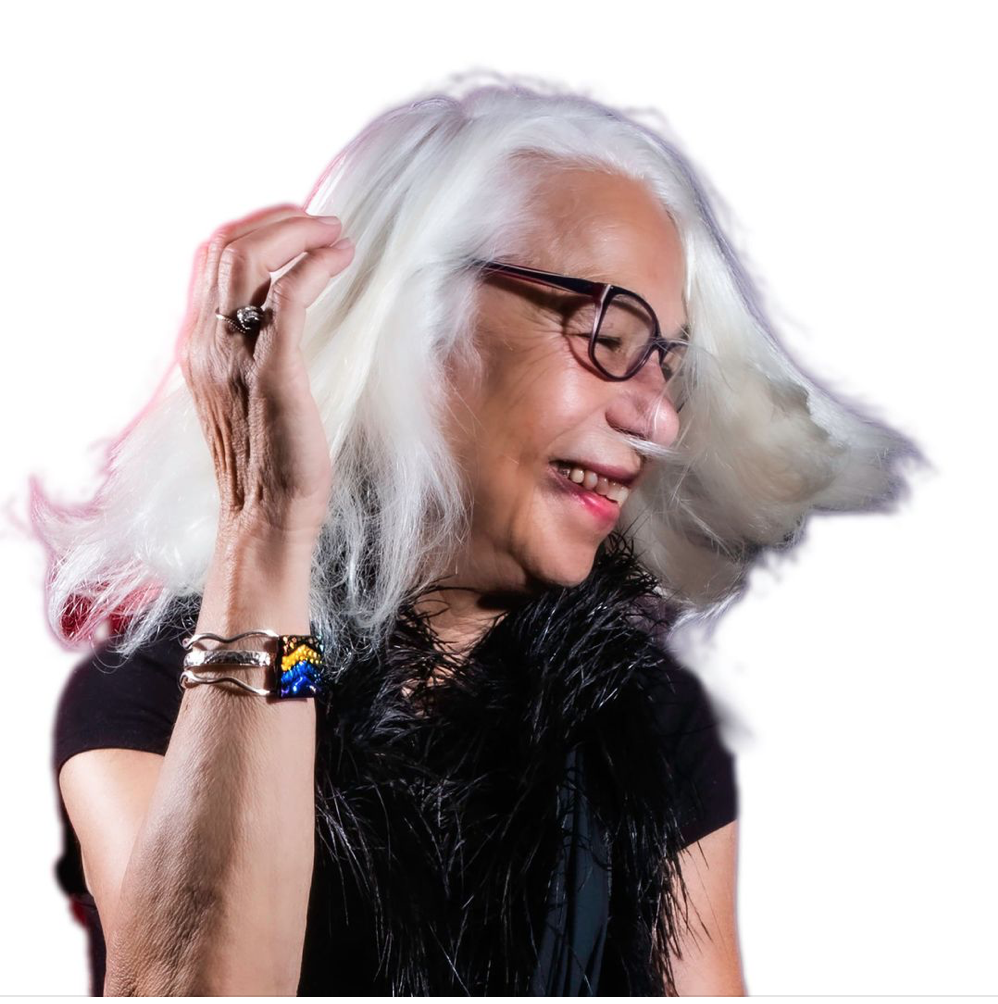
Raised in the Bronx and now based in Oakland, Lenore Weiss is the author of a novel, Pulp into Paper, and multiple poetry collections, including Video Game Pointers (2024) and a trilogy exploring love, loss, and mortality. Her prize-winning flash fiction chapbook, Holding on to the Fringes of Love, was published by Alexandria Quarterly Press. A member of the San Francisco Writers Grotto and Associate Creative Nonfiction Editor for Mud Season Review, she has collaborated across disciplines, most recently on Life into Light, a chapbook about photosynthesis created with scientist Dr. John Bedbrook. She is currently working on her second novel, tentatively entitled "Not a Good Season for Trust." Lenore has led writing workshops and tutored middle school students.