
Charcoal Husband // Tomias Keno
from judge Teresa Carmody: With humor and playfulness, “Charcoal Husband” explores the uncanniness of connection—how those closest to us can become the most unfamiliar: forgotten, strange, the ones we can no longer quite remember. And then it’s the whole community, trying and failing to help us see what we cannot—the full, shifting complexity of ourselves and of others.
They’d put her in the side room by the vestry, the dusty one, where spare chairs were stacked to the ceiling, and a faded poster declared “Welcome new believers” in a font last seen on a yogurt lid.
From the sanctuary came the soft rustle of people trying not to rustle, a few strategic coughs, and someone’s phone bursting cheerfully into “Angels” by Robbie Williams. There were one hundred and forty-seven people out there. She knew because her mother had mentioned it roughly one hundred and forty-seven times during the planning.
“You don’t want to come out because...?” asked Kaylee, the Maid of Honor, leaning in at a cautious forty-five degrees to keep her hair from brushing the doorframe.
“Because I can’t remember his face,” said the bride, as calmly as ordering a salad. She hoped the calm might make it sound less strange.
“But it’s just... it’s Dan.”
“Right,” the bride said. “Dan, sure.” She could remember Dan’s voicemail: Hi! It’s Dan! Leave a message after the beat! followed by truly terrible beatboxing. She could recall his handwriting, somewhat. His neck, definitely, five angles of it, especially the angle when thinking hard.
Kaylee smiled a smile that was sympathetic, but not so sympathetic that it looked like she’d chosen a side. “What if you close your eyes and try again?”
So the bride did. Tried again to find him. A sturdy nose, maybe. Lips with volume. Kind eyes? People always said kind eyes about men with nothing else to recommend them. And she needed a recommendation, a reason. Without his face, the man of her dreams was suddenly just... a man. And marrying any man wasn’t really her sort of thing.
From the hallway came a whisper, not nearly quiet enough: “How’s she doing?”
“She’s trying,” Kaylee answered.
The bridesmaids slid in then: three women in a colour that had been described in the email chain as “sage,” but in real life leaned more toward “unicorn pink.”
“Sweetheart,” said the one with the clip-on ponytail, crouching until her knees popped audibly. “We hear you’ve gone a bit... wobbly.”
“I can’t see him,” the bride said. It felt like confessing she’d started doubting the moon landing.
“Don’t be daft,” another bridesmaid said, whipping out her phone and scrolling through a gallery of men who all could plausibly be hers, each holding a drink. “There!” she said triumphantly, landing on one of him by a barbecue, squinting like sunlight was a personal enemy. “Face.”
“If that’s him,” the bride said, “then he’s better at being a photograph than a person.”
The bridesmaids laughed that particular laugh women do when something isn’t funny. Then they looked at one another, as if, between them, a solution might appear. Only silence did, and the distant sound of a flushing toilet.
When the bridesmaids drifted out, others drifted in: a slow procession of girlfriends and distant cousins, drawn by curiosity and duty, armed with good intentions.
“Honey,” Aunt Rita said, sitting so close their dress fabrics whispered against each other. “He’s a good man. He brought paper plates to my barbecue without being asked. Who does that? A good man.”
The bride nodded. She could picture paper plates, yes. But not the face handing them over.
“If you can’t remember his face, so what?” Aunt Rita continued. “What is a face, really? Nostrils. Holes! You’re not marrying holes.”
“Eyes too,” Kaylee offered, trying to be collaborative.
The bride wanted to say: But it matters that I see him. It matters that when I imagine him saying, “I do,” I see the particular shape of his mouth making it. That’s how you promise. Otherwise, it’s like promising to a crowd. But she only nodded.
Then came another woman, relation unclear, who pressed a hard caramel into her hand and said: “My Harold never had much face to speak of, and we’ve survived thirty-two years.” The bride wanted to find that comforting, but it only conjured an image of herself on a sofa beside a lifelong blur.
The room was filling fast with helpful women and unhelpful advice. Voices overlapped until the door opened and conversation dropped dead. The bride’s mother entered the room the way celebrities do in supermarkets. “I have been sent,” she announced. “Honestly, darling, this is melodrama. You’ll remember him the second you see him. You’re just having a moment.”
“I’m having a moment where I cannot recall his face,” the bride said, slumped in the only nice velvet chair, hair as defeated as her voice.
“That’s perfectly normal. I couldn’t remember your father’s face until well past the
honeymoon.”
The room went quiet. Even Kaylee stopped pacing. The bride looked at her mother
properly for the first time all morning.
Her mother adjusted her weight, resettled her handbag on her arm. “Well, I mean,
obviously I knew what he looked like... in theory. But if you’d asked me to describe him, really describe him, to pick him out of a crowd or what have you...” She trailed off. “The point is, faces are not what marriage is about.”
“What is it about, then?”
Her mother looked genuinely flustered now, a rare event for a woman who held strong opinions about the correct orientation of cutlery in the dishwasher. “It’s about partnership,” she said finally. Then, in a careful tone, like unlocking an old safety deposit box: “I have never, not once, kept a face for any man. They blur. But the senses make up for it. Smell gets heightened, for instance.”
“The smell of men?” Kaylee asked, brushing imaginary dust from her sleeve as if the very idea might stain her.
“Of course, men,” her mother said briskly, as though the question were indecent. “I can draw your aunt Susan’s pores from memory.” Aunt Susan nodded proudly.
Then the door opened, and in swept Dan’s mother, carrying the expression of a woman who might be about to lose a deposit. “Is she...?” she began, then saw the droopy bride and transformed the concern into a smile. “Sweetheart. He is beside himself.”
“Men don’t love being humiliated,” her own mother said, kneeling to tug at the bottom of the bride’s dress as if smoothing out wrinkles might restore her memory. “Think of Dan. He’s a catch.”
Everyone nodded. The bride thought of Dan catching things: a bus, a cold, the jar she’d once dropped, making pasta. “A catch,” she repeated, as if saying it might reel in his face.
Dan’s mother knelt beside her and clasped her hands. “I raised that boy,” she said. “He’s a good boy. Not perfect, nobody is, but good. He’ll never leave a thing half-done. Laundry? He’ll finish it. Conversation? He’ll finish it. If he tells you he’ll be somewhere, he’s there.”
“He was late to our second date,” the bride heard herself say.
“Traffic,” Dan’s mother said swiftly. “Probably a missed turn. He doesn’t do well with lefts. My family, we’re not a left family. But you know that by now.”
Her mother nodded. The two women stood like mismatched bookends: hers tall and
angular, Dan’s small and round. Different shapes, same expression: waiting for her to come to her senses. And she wanted to, she just couldn’t remember where they were.
“Describe him for me,” the bride asked. “Without saying, good boy. Without mentioning his job, his hobbies, or the way he makes roast potatoes. Describe how he looks.”
Dan’s mother lifted her hands, palms up, and made little sculpting motions in the air, as though kneading the idea of him. “He has a... warmth,” she said.
“So does a radiator,” said the bride, not unkindly.
“His eyes,” her own mother said, hand darting. “They’re very... present.”
“Eyes must be. It’s biology,” said the bride. “Otherwise, we call a doctor.”
The smallest bridesmaid, revived by the chance to finally be helpful, added: “He’s six foot.”
“That’s a length,” the bride said.
There was a small, sympathetic laugh across the room, then quickly suppressed, like a sneeze in a lift. For a moment, they all thought. The bride could feel it happening, the slow bloom of an idea, something subversive, a little oil spill spreading: maybe it wasn’t unreasonable to want a face to love. Without one, you were left with a man. And a man, as a category, was rather a lot.
The bride wondered what the groom was doing out there with his uncooperative face. She pictured a kindergarten drawing of a man: round head, two coin eyes, a line for a mouth. She hoped he wasn’t sad. She didn’t want to be the cause of male sadness, but she also knew men’s sadness had a way of expanding until it needed its own postcode. What about hers?
The vicar’s wife entered with the efficiency of a woman used to patching crises. “We’ll say there’s been a leak,” she said. “There’s almost always a leak in these old buildings.”
Aunt Susan tilted her head. “Well, he does have nice teeth,” she offered, but no one could quite picture them anymore.
***
Because women are a natural committee, they instantly formed a focus group. Within minutes, someone had fetched a cousin who used to draw criminals for the police and now did commissioned portraits of Labradoodles. She arrived with a charcoal pencil and authority, sitting on a folding chair as if it were a throne.
“Describe his face,” said the sketch-artist cousin, whom the bride mostly remembered for selling wax melts on Facebook. “Start with the top. What’s his hairline doing?”
A pause. No one wanted to say balding in a church. “It’s... tidy,” Kaylee offered.
“Eyes?”
“They’re a normal color,” said the organist’s wife, beginning to sweat.
“A nice smooth brown,” a bridesmaid added, cautiously. The bride pictured gravy and wished she hadn’t.
The cousin’s charcoal began to gather shape: a forehead, an earnest brow. Half a man, but more than a blur. It worked better than the photos, the bride thought. A drawing, even half finished, felt closer to memory; less about accuracy, more about point of view.
“His mouth,” one of the bridesmaids said. “Always thought it looked a bit... animal.
Moose-ish, maybe.”
The bride flinched hard enough for a curl of hair to spring loose. Everyone noticed.
“Teeth!” Aunt Susan blurted, with the false cheer of someone yanking a conversation back from the brink. “What about teeth?”
“We’ve acknowledged teeth,” the bride’s mother hissed. Never a good sign, the bride thought, when the entire room had already pictured them once and chosen not to revisit the experience.
A teenage cousin appeared in the doorway, eyeliner sharp enough to notarize documents. “I’ve always thought Dan looks rather like a man from a car insurance advert,” she said, leaning against the door frame. “No offense.”
“We’re being positive, Zoe,” hissed a bridesmaid.
“I am being positive,” said Zoe. “Someone somewhere might call that hot.”
The women sighed as one. They could all see it now: the man appearing on the paper wasn’t someone you’d cross a room to marry. He was someone you’d politely let merge in traffic. They began to argue, gently insisting that faces didn’t matter, composing small mercies for the chap on the paper. The bride recognized the tone: the same one women used when convincing themselves to keep walking: down aisles, into houses, into compromises shaped like people.
Aunt Rita tried her usual refrain: her husband could fix things around the house. But at least Rita could see the man fixing things, could recognize the face she loved and called hers.
“Listen,” said the bride, sitting up in her velvet chair. Her tone made them all lean in.
“You all know his face, but imagine him, as I must, without one. Picture just the blur of a man. Would you be thrilled to go home to such a blur? Every night? Forever? The blur will have opinions about shelving. The blur will say, ‘I don’t think we should get a dog.’ The blur will, at Christmas, buy you something with the word set on the box. But if there’s a dazzling face instead of the blur, or at least one that feels like home, you forgive him everything else, because you have something to hold, a place to rest your wanting. Without it, all you’ve got are the logistics of a blur. Do you see?”
They did. You could watch the understanding pass through them, a neat little relay. Yes, oh God, yes; Christ, the blur. The organist’s wife looked faintly ill.
Dan’s mother, bless her, made a final stand. “He has dimples,” she said, gripping the word like a handrail, but the damage was already done.
The room had the hush of women examining evidence from a crime they hadn’t realized they were part of. “He once said he makes a mean risotto,” Aunt Susan said. “I asked what’s in it, and he said, ‘Whatever she tells me to.’”
“He eats yogurt with a fork if the spoons are dirty,” said his sister, who had been quiet until now.
“He claims he’s vegetarian,” said Zoe, “except for kebabs.”
The vicar’s wife, who had seen many marriages up close and had a professional interest in them not collapsing, tried to perform a tiny reset. “All right,” she said, kind but brisk. “What we are confronting here is that attraction, specifically facial, is the lubricant that makes the machine go without smoke. And if the lubricant is gone...”
A timid knock interrupted her. One of the ushers poked his head in, smiling with the
earnest optimism of a Labrador. “Just to say: we can fit in another hymn, if that helps? Or maybe something modern? People like modern.”
The vicar’s wife guided him out gently, narrating an image of the women mopping puddles together.
“Life with a man can be delightful,” Aunt Rita said, attempting to finish the thought, but the sentence had the weary tone of someone describing a cat who sometimes comes when called. “There are... kindnesses.”
The women looked at each other with that frank, conspiratorial kindness they reserved for moments when the truth got out accidentally. The bride could feel them all tilting, gracefully, toward a shared realization.
“We are not against men,” the bride’s mother said diplomatically, to the air. “Men are fine. They’re like street signs: you’re glad they’re there. But you don’t take comfort from a sign you’ve never seen before. You want the one that tells you you’re nearly home.”
A bridesmaid giggled, then slapped a hand over her mouth, as if she’d just violated a church law.
“Does that mean we can start?” asked Kaylee. “I’ve got a thing at three.”
Before the bride could answer, the door creaked open with the slow hinge of someone afraid to interrupt. “Hey,” said a man, the word landing in the room just ahead of him. His voice had that soft, friendly register the bride remembered from so many small moments: post office lines, whispered jokes in bed, the time he’d spoken to a bird that flew into the house.
But when she saw him, the real, physical him, the remembered Dan refused to appear. A few parts clicked (oh, that chin; those eyelashes, yes), but mostly she saw someone new. The lines deeper; the hair slightly thinner. Not bad, she thought. For a stranger.
She noticed a scar on his left eyebrow she’d never clocked before, a pale line, as if
someone had taken a pencil to him and changed their mind halfway through. After today, she would always see that scar. She wondered how much else she had missed: maybe a crooked tooth behind his lip, or a twitch of the nostril when he was about to lie.
Dan said nothing. Just looked faintly panicked, as if he could smell what they’d been talking about. Then her brother barged in. “Sorry to bother you,” he said to the room full of women. “It’s just, Dan’s got this little problem with... memory.”
“Only the face,” said Dan. “I remember everything else.”
“Join the club,” said the bride.
Dan’s face did a small, familiar thing, an almost-smile that never quite made it. She felt a slight click of recognition. Not for his face, but the kindness that had always lived behind it. It felt like a relief in the stomach, something quietly untangling.
“I couldn’t pick out Harold’s eyes in a line-up,” Aunt Rita began cheerfully. “But he’s got this dent.” She tapped her forehead. “Says it’s from a cricket ball in ’84, though we weren’t yet acquainted in ’84, so I cannot verify. Still, I’ve loved that dent like a family pet.”
“Naso-labial fold,” Aunt Susan intoned, with the devotion of someone reciting scripture. “On Lilian, it runs deep, like the path water carves when it’s patient. Sometimes I dream of that fold.”
“Birthmark,” shouted the organist’s wife, her eyes bright. “He has one on his forehead. If it vanished, I’d be bereaved.”
There was murmuring, nods. Someone said, “Crow’s feet,” softly, like a pilgrim naming a shrine.
“Every one of you has a smaller nose than I,” murmured the bride’s mother, as if
confessing to a crime.
“I have one ear that’s lower,” said Kaylee, tugging her hair to show it. “In photos I tilt, like I’m eavesdropping on a secret.”
Bridesmaid Chloe began to cry. “I keep forgetting my children’s faces,” she said. “Google says hormones. I truly hope so.”
And then the litany gathered rhythm, a cadence. They spoke of freckles, eyebrows, and the myth of symmetrical nostrils. Of mouths not as kiss-machines but as small, unique puzzles: lips that met reluctantly, lips that gaped a little.
People who hadn’t been invited began to drift in, drawn by the strange electricity of
honesty. Someone laughed, and then everyone did, the kind of laughter that isn’t cruel, just human. A shared relief at the absurdity of all of us, walking around, wearing faces.
Through it all, the bride and groom stood together, as if posing beside a museum exhibit. Their hands found each other. Warmth flowed between them, carrying wordless messages. He fidgeted; so did she. She squeezed him. He squeezed back the exact amount, the honest clasp of someone with nothing to prove and nothing to hide.
The charcoal drawing lay on the floor: a faint smudge of a man, not yet trampled but well on its way to being forgotten.
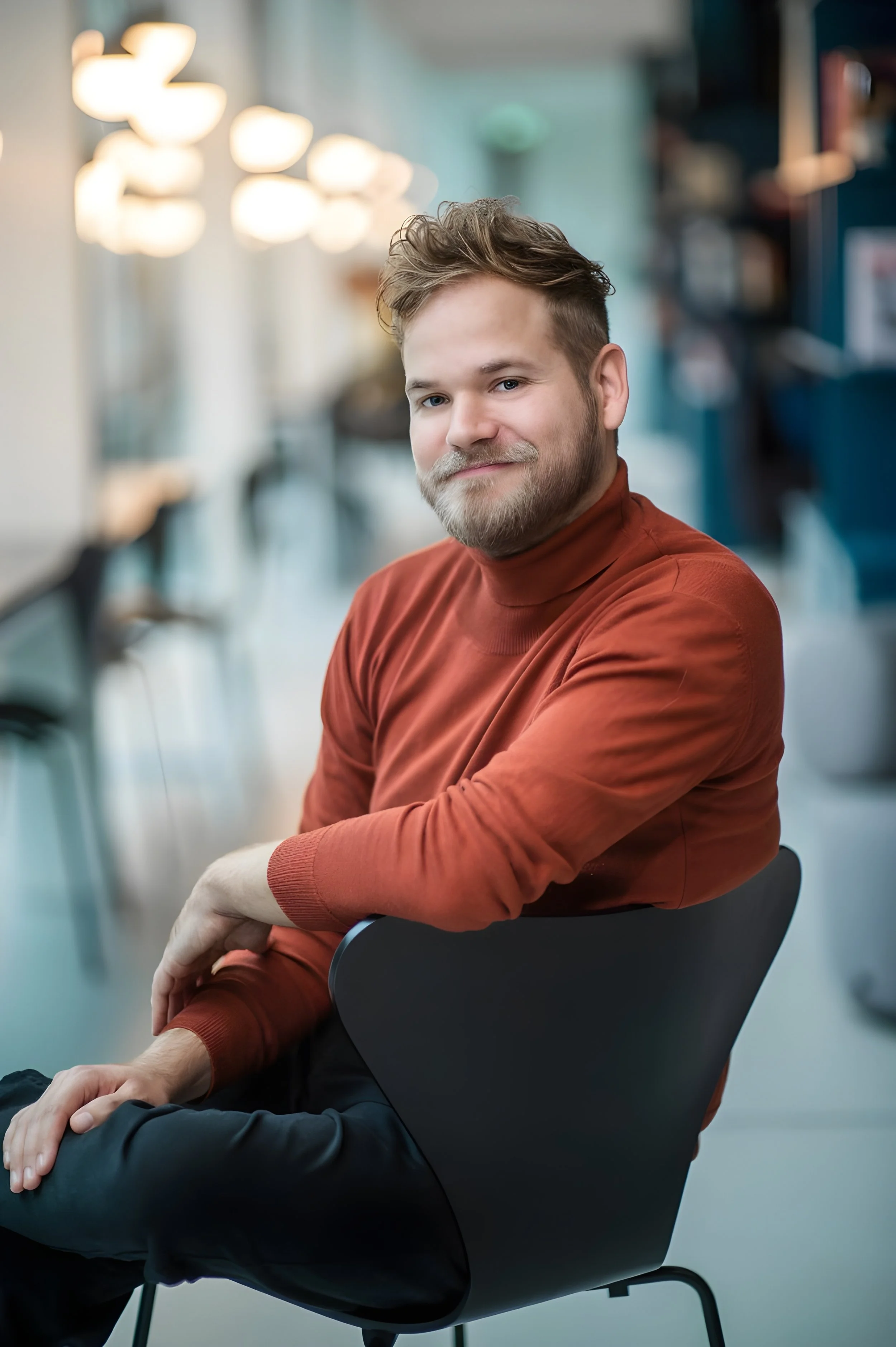
Tomias Keno (1990) is a Dutch author, screenwriter, and singer-songwriter working at the intersection of literary fiction and science fiction. His work won first prize at the 2025 Dubai Future Stories Awards, held during the Dubai Future Forum. His literary fiction has appeared in Dutch literary magazines, including Op Ruwe Planken, DwB, de Optimist, and deFusie, and he is a finalist for the 2026 Indiana Review Prize. In 2022, he launched Astronaut, a multidisciplinary project combining a novel, a fiction podcast, and a pop album; the podcast became the most listened-to fiction series in the Netherlands and Belgium and was nominated for the Rose d’Or, the NTR Podcast Prize, and the Belgian Podcast Awards.