
VARIANT UNCATALOGUED // LAUREN KELLEY
Notice of Violation
Municipal Code §14.3 — Improper Concealment
The subject was first seen at 09:42 a.m. near the intersection of Alder and Fifth. Weather conditions were mild. Foot traffic was moderate. The subject appeared calm. No records indicate when the subject first began appearing at the intersection. Archival footage from the crosswalk installation shows a figure in the background with cranial extensions similar to those of the subject. Identity unconfirmed.
Two horns extend symmetrically from her skull, starting just above the temples and curving outward before tapering to rounded points. They are not ornamental. Growth rings are visible along the curve, layered and spaced, indicating age. No surgical seams or attachment points are observed. The material does not resemble resin, bone, or any cataloged composite. Their width exceeds average shoulder span and could obstruct peripheral pedestrian traffic if not properly managed.
Measurements were not taken during the initial contact. The measuring tape retracted before a final number could be confirmed. A second attempt yielded an inconsistent span.
The subject’s torso was partially concealed by foliage. The leaves were deliberately arranged and secured with a thin cord at the back. Coverage met minimum opacity standards but was considered interpretive.
When informed of the complaint, the subject did not express surprise.
“Is it the horns,” she asked, “or the leaves?”
The responding officer clarified that the issue was concealment, specifically concealment indicating affiliation, ritual, or ideological intent. Municipal guidelines require attire to be materially sufficient and culturally non-provocative.
“Does it require removal, or only translation?” she asked.
A symbol was marked on the subject’s forehead: a five-pointed star inside a circle. The lines were precise and deliberate, not accidental. The officer recorded it as “marking—self-applied.”
Several bystanders reported feeling uncomfortable. One described the subject as “defiant.” Another mentioned, “children present.” One complainant stated the subject “did not appear ashamed.” Another noted she “maintained eye contact longer than necessary.” A third expressed concern that “children might assume this is permitted.”
It should be noted that the subject neither approached nor spoke to any of the complainants. The pigeons did not startle when she passed. Dogs did not bark. The wind altered direction slightly along the curvature of her horns.
She stood at the crosswalk. She waited for the signal. She crossed when instructed.
The ordinance does not ban horns. No language addresses cranial extensions that are biological or ornamental. Concealment, however, must not amplify their presence.
The subject was issued a written warning and provided with recommendations for corrective action:
Replace the organic covering with a neutral-toned fabric.
Remove or obscure visible symbolic markings.
Consider cranial compression devices if feasible.
The subject accepted the notice. She folded it once and placed it between two leaves against her sternum.
At the follow-up inspection three days later, the subject had partially complied.
The foliage had been cleared and replaced with a uniform layer of municipal gray. Coverage exceeded minimum requirements. No organic material was visible.
The pentagram had been replaced with a barcode. No scar tissue was visible.
The lines were precise. Machine-readable, though no registry returned a match.
When asked about the change, the subject stated, “It scans.”
The officer attempted to verify this claim using a handheld device. The scanner emitted a confirmation tone without classification.
No further complaints were filed that afternoon. Pedestrian traffic returned to normal patterns. Children passed by without incident.
The horns remained.
From a distance, the barcode appeared less intimidating. It suggested inventory rather than invocation. Containment rather than threat.
The subject’s posture did not change. Shoulders back. Chin level. Eyes forward.
It was observed that people made space for her on the sidewalk. No obstruction occurred.
Under the current municipal code, the subject is now compliant.
A recommendation has been submitted to the council to review §14.3 for language regarding expressive concealment. Several members expressed concern that the absence of foliage may be perceived as an escalation rather than a correction.
No action has been taken at this time.
The subject continues to appear every day at 09:42 a.m. near the intersection of Alder and Fifth. She waits for the signal and crosses when instructed.
The horns cast longer shadows in the afternoon.
They fall across the crosswalk lines without distortion.
The crosswalk timing has not been adjusted to account for her shadow.
No ordinance addresses shadows.
Language is under review.
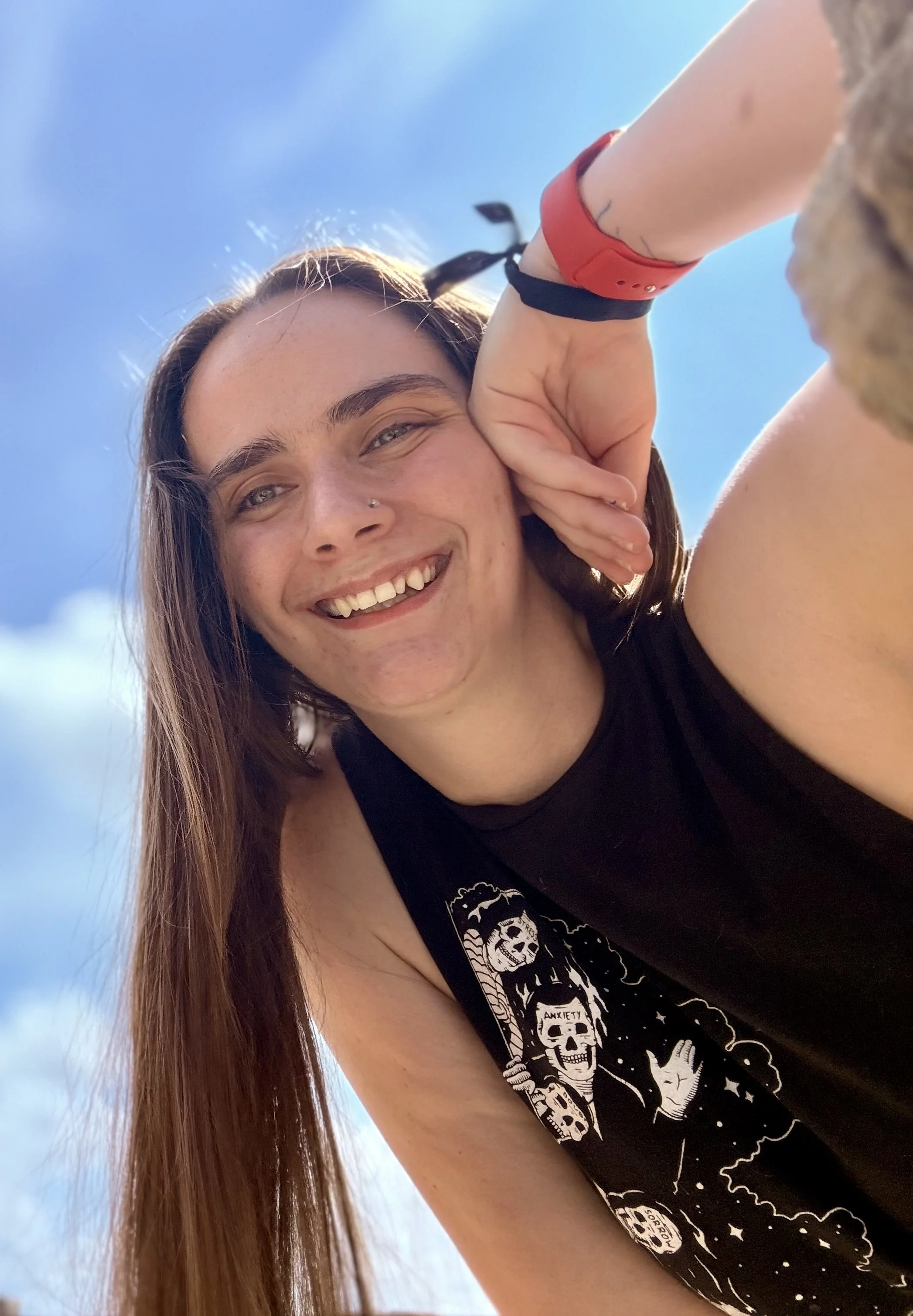
Lauren Kelley is a writer from Minnesota whose work explores memory, uncertainty, and the places where the ordinary slips sideways. Her work has appeared in Foglifter Press and Ilanot Review and is forthcoming in several literary journals. She lives with her husband and a small constellation of animals. Find her at unreliableonpurpose.com.